Skip to main content

How the Supreme Court Addressed Threshold Barriers for Trucking Accident Victims
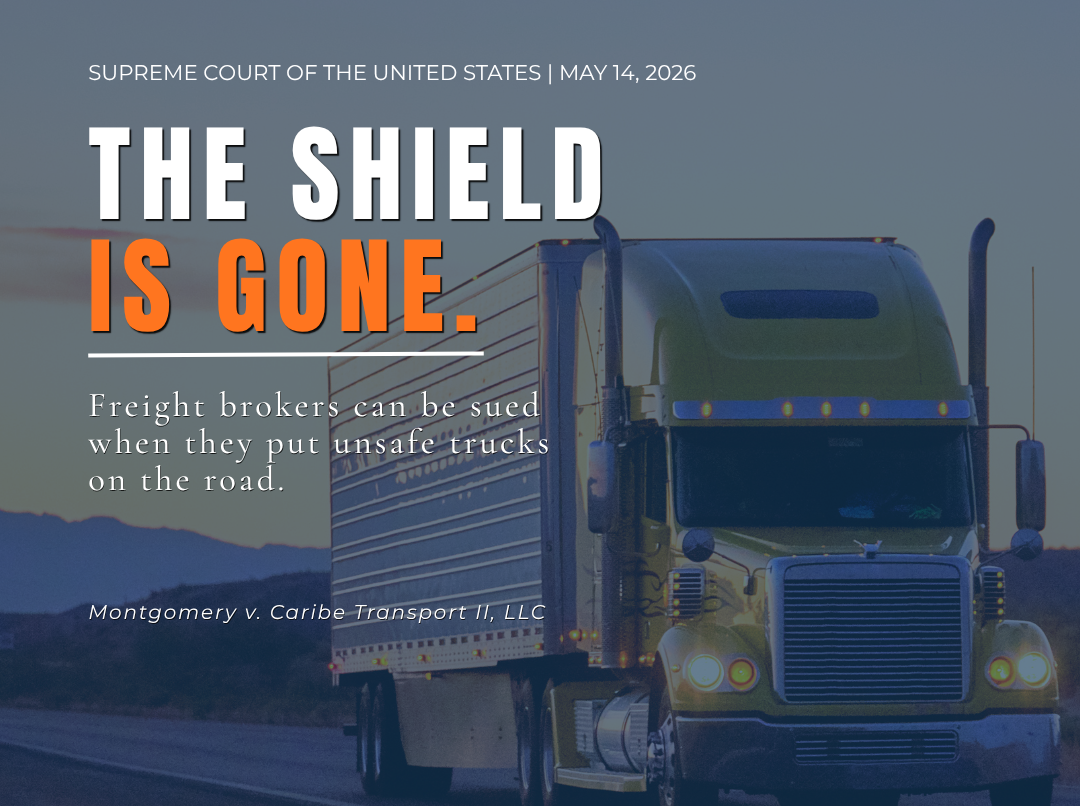
For years, personal injury attorneys handling commercial vehicle crashes faced a major obstacle when bringing negligent hiring claims against freight brokers. The Federal Aviation Administration Authorization Act, known as the FAAAA, was frequently used to argue that state law claims were preempted because they related to broker prices, routes, or services.
On May 14, 2026, the Supreme Court decided Montgomery v. Caribe Transport II, LLC and unanimously held that a negligent hiring claim against a broker can fall within the FAAAA safety exception and is not preempted. The Court resolved a circuit split, confirming that states retain safety regulatory authority with respect to motor vehicles, including through common law negligent hiring claims. This decision narrows the ability of brokers to use preemption to defeat safety claims, allowing more cases to move into factual development.
A Shift in the Broker Preemption Defense
Before Montgomery, brokers regularly argued that negligent hiring claims were categorically preempted. The Supreme Court rejected this approach. Writing for a unanimous Court, Justice Amy Coney Barrett explained that the FAAAA preemption clause is broad but not absolute because Congress preserved the safety regulatory authority of a State with respect to motor vehicles.
The Court made clear that the ruling does not eliminate preemption across all broker litigation. State laws related to prices, routes, or services that have no relationship to motor vehicle safety remain preempted because the safety exception saves only a subset of claims. The decision makes it harder for brokers to obtain early dismissal on preemption grounds. It does not guarantee liability, but it allows claims to proceed to merits discovery when the complaint plausibly ties the conduct of the broker to motor vehicle safety.
Clarifying the Scope of Safety Regulation
The legal question turned on 49 U.S.C. Section 14501(c)(2)(A), which states that preemption shall not restrict the safety regulatory authority of a State with respect to motor vehicles. The broker defendant argued that because brokers do not own or operate trucks, their carrier selection decisions were too attenuated from motor vehicles to fit the exception.
The Court rejected that argument. Applying the ordinary meaning of the phrase “with respect to” as concerning or regarding, the Court held that a claim is with respect to motor vehicles if it concerns the vehicles used in transportation. Because the selection decision of the broker determines which truck will transport the goods on public highways, requiring ordinary care concerns motor vehicles and falls within the safety exception. The opinion confirms that state common law duties form part of a State authority to regulate safety.
Notice and the Role of Federal Carrier Ratings
The facts of Montgomery show why federal safety information matters. Shawn Montgomery suffered severe injuries, including an amputation, after his tractor trailer was struck by a truck operated for Caribe Transport II, a shipment coordinated by C.H. Robinson. The complaint alleged that Caribe Transport had a conditional safety rating from the Federal Motor Carrier Safety Administration when hired, with deficiencies involving driver qualifications, hours of service, and vehicle maintenance.
Under this framework, a conditional rating is evidence of notice and foreseeability that plaintiffs can use to support a claim, though the prima facie standard remains a matter of state law. The Court did not hold that any rating automatically establishes breach.
Evaluation of Federal Carrier Ratings
- Satisfactory: Indicates adequate safety controls are in place. Plaintiffs can use this baseline to seek further discovery into underlying safety data or recurring patterns.
- Conditional: Indicates inadequate safety controls and that improvements are required. This provides evidence of notice and foreseeable risk to support a negligence theory.
- Unsatisfactory: Signifies severe violations where the carrier must cease operations. Hiring such a carrier serves as strong evidence of breach to argue no reasonable broker should have relied on them.
- Unrated: Means no comprehensive audit has been performed. This supports the argument that a reasonable broker must conduct independent vetting before dispatching the carrier.
Discovery and Litigation Strategy
Brokers can no longer rely on FAAAA preemption as a categorical basis to avoid early-stage discovery in safety based negligent hiring cases. While brokers may still raise standard objections like relevance or privilege, properly pleaded claims are less likely to be terminated solely on preemption grounds. This makes several discovery avenues critical:
- TMS audit trails showing when a broker accessed a carrier profile and what information was reviewed.
- Internal communications showing how personnel evaluated known safety concerns.
- Third party vetting service logs reflecting safety alerts or prior crash information available before the load was assigned.
- Carrier onboarding materials that may reveal discrepancies in identity or registration.
Proximate Cause and Concurrence
Justice Kavanaugh, joined by Justice Alito, filed a concurrence noting that this was a close case. He emphasized that the proximate cause requirement in typical state tort law should help protect brokers from excessive liability, noting that brokers who act reasonably and hire reputable companies should defend these suits successfully. Plaintiffs must still prove all substantive elements of their state law claims, including duty, breach, causation, and damages.
Clark, Fountain, Littky Rubin & Whitman represents seriously injured victims and surviving families in complex commercial trucking cases. If you or a family member has been injured in a crash involving a freight broker, contact our firm today for a confidential consultation.