Skip to main content

Clark Fountain Obtains Significant Confidential Settlement Against Vehicle and Seat Manufacturers in Catastrophic Seat Failure Case
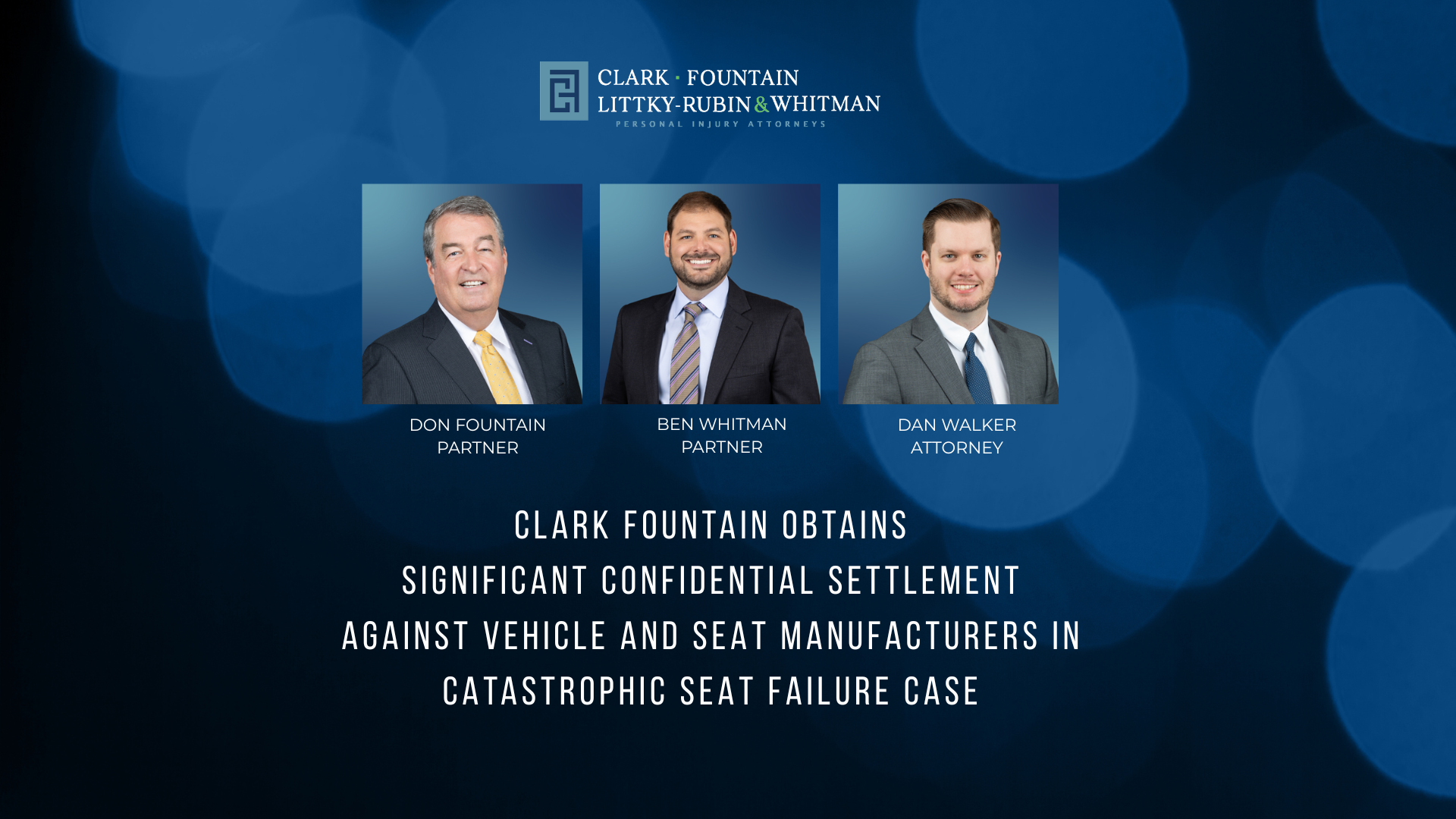
Palm Beach Gardens, FL – Attorneys Don Fountain, Ben Whitman, and Dan Walker of Clark Fountain, alongside co-counsel Drew Ashby, have obtained a significant confidential settlement just weeks before trial in a major automotive product liability case involving both the vehicle manufacturer and the seat manufacturer.
The case centered on a driver who did everything right. The client was properly seated, wearing a seatbelt, and had no fault in the rear-end collision. The crash itself was survivable. The driver who struck the client declined medical treatment at the scene.
But inside the client’s vehicle, the driver’s seat failed.
Instead of maintaining its structure and helping keep the driver safely contained, the seat fractured across several critical components. The failure caused the client to be thrown rearward over the collapsing seatback, resulting in a devastating spinal fracture and immediate paraplegia. After months of serious medical complications, the client ultimately died from the injuries.
Clark Fountain’s investigation, conducted with engineering, vehicle and seat design, accident reconstruction, failure analysis, metallurgy, radiology and biomechanical experts, focused on how a properly restrained driver could suffer such catastrophic injuries in a rear-end crash of this severity.
The investigation identified a series of structural failures within the seat assembly. The collapse began near a 1.78-inch by 1-inch rectangular opening stamped into a load-bearing metal bracket to allow a wiring harness to pass through the seat structure.
From there, the failure spread. The outboard bracket fractured at the stamped opening. Another portion of the bracket sheared near the reclining mechanism. The inboard seat bracket also fractured, and the headrest post guides bent and broke.
Together, those failures allowed the seatback to twist and collapse more than 70 degrees on one side. Once the seat collapsed, the seatbelt could no longer keep the driver properly positioned.
The client moved up and backward over the seatback, causing the failing seat to act as a fulcrum against the driver’s spine. The resulting hyperextension caused a spinal fracture and immediate traumatic paraplegia.
“This was not a seat that simply bent backward during a crash,” said attorney Don Fountain. “Multiple parts of the seat structure failed. When that happens, the seatbelt and the rest of the occupant protection system can no longer work the way they were designed to work.”
Fountain added, “A vehicle seat has one of the most basic safety jobs in a crash: keep the occupant supported and in position. When a design weakens a load-bearing part of that structure, the consequences can be catastrophic, even in a collision that should have been survivable.”
The case was resolved through confidential settlements with both the vehicle manufacturer and the seat manufacturer shortly before trial.
About Automobile Seat Design and Safety
A vehicle seat is more than a place to sit. The seat, head restraint, and seatbelt are designed to work together to protect an occupant during a crash.
In a rear-end collision, the seatback must remain strong enough to support the occupant and help manage the forces created by the impact. If structural brackets, recliner components, headrest supports, or other parts of the seat break, the occupant can move out of the position the restraint system was designed to protect.
That movement can lead to what engineers call “ramping,” where the occupant moves up and over the collapsing seatback. In serious cases, this can expose the head, neck, and spine to devastating forces.
Investigating a potential seat defect requires a careful examination of the entire seat structure, including brackets, stamped openings, recliner mechanisms, headrest guides, welds, fasteners, and the materials used to build the seat. It also requires understanding how those components performed together during the actual crash.
About Clark Fountain
Clark, Fountain, Littky-Rubin & Whitman is a nationally recognized plaintiff personal injury and product liability law firm based in Palm Beach Gardens, Florida. The firm represents individuals and families in catastrophic injury and wrongful death cases involving defective vehicles, dangerous products, and other complex claims.
Clark Fountain represented injured victims across the country involving defective seats and restraint systems, airbags, tires, vehicle structures, rollovers, and other automotive safety defects. The firm works with leading engineering, biomechanical, and accident reconstruction experts to investigate how products fail, identify responsible parties, and hold manufacturers accountable when unsafe designs cause serious injury or death.